
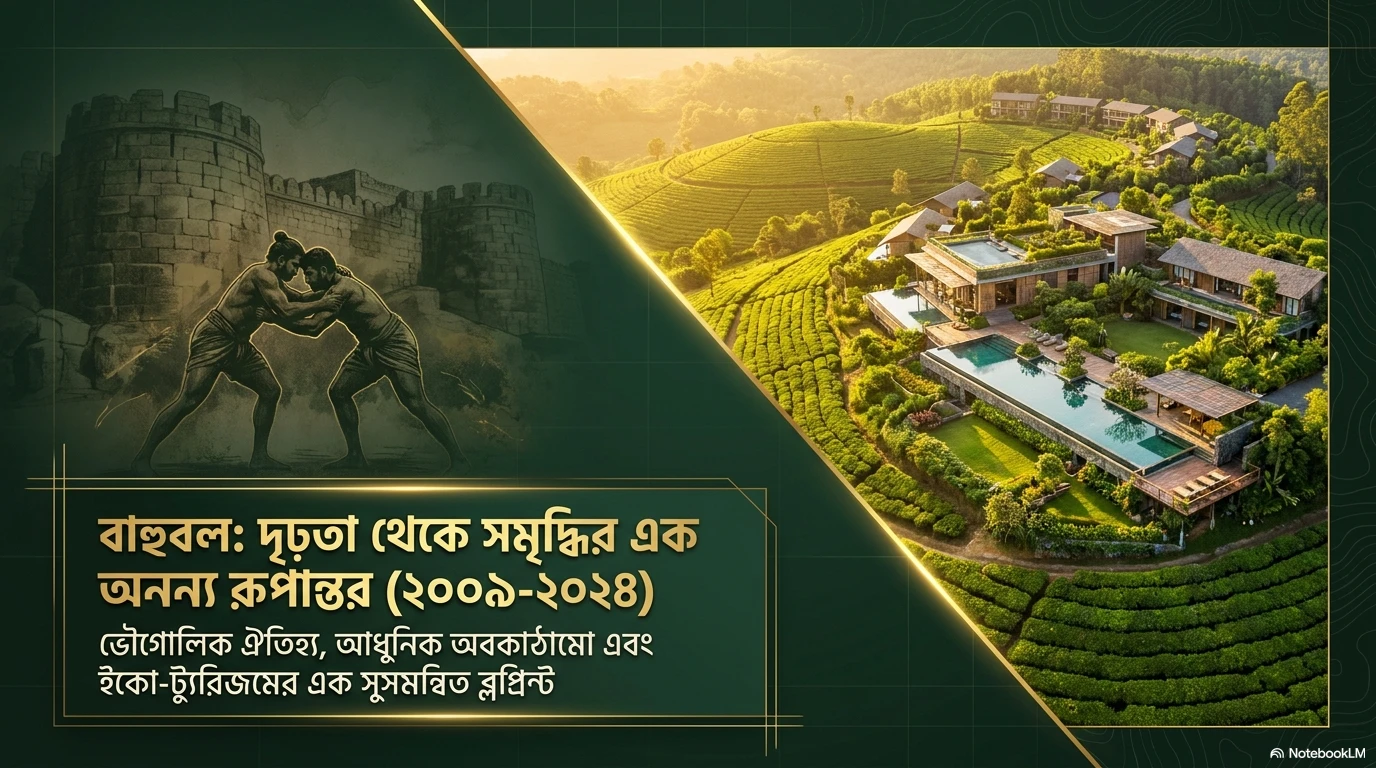
Comprehensive Analysis of Socio-Economic Development, Infrastructure, and Cultural Heritage in Bahubal Upazila: 2009–2024
The socio-economic landscape of Bahubal Upazila, situated within the Habiganj District of the Sylhet Division, represents a complex interplay of historical legacy, ecological abundance, and targeted state-led development. Between the years 2009 and 2024, this region has undergone a significant transformation, moving from a predominantly agrarian and isolated administrative unit to a focal point for luxury eco-tourism, modern religious infrastructure, and pioneering housing rehabilitation projects. The analysis of this period reveals a transition where traditional structures—such as the colonial-era tea estates and the ancient Taraf-based social hierarchies—have been augmented by the decentralized governance of the upazila system and the expansion of the national power grid. The subsequent report provides an exhaustive examination of these shifts, utilizing demographic data, historical records, and infrastructure development reports to synthesize the evolution of Bahubal.
Historical Genesis and Administrative Transformation
The historical identity of Bahubal is inextricably linked to the medieval kingdoms of the north-eastern frontier of Bengal. In the early medieval period, the region was intermittently ruled by the Buddhist and Hindu dynasties of Harikela and Kamarupa, eventually passing to the control of the Chandra, Sena, and Deva dynasties.[1] Within this broader geopolitical context, the specific territory of Bahubal was part of the Tungachhal Kingdom, which functioned as a vassal state of the Gour Kingdom.[1] The fall of Tungachhal in 1303 CE remains the most pivotal event in the local collective memory. This occurred during the Conquest of Taraf, led by the Sufi saint-warrior Syed Nasiruddin and his twelve associates (lascars), who defeated the last Raja of Tungachhal, Achak Narayan.[2] This military and spiritual conquest catalyzed a demographic and religious shift, establishing the influence of the Syed zamindar dynasty in the area—a lineage that eventually founded the town of Habiganj.[1]
The name “Bahubal” itself is a testament to the region’s historical reputation for physical strength and martial prowess. Local folk tradition narrates an encounter between two famous wrestlers: a visitor from Dakshinbhag in Moulvibazar and a local named Qudrat Mal.[2] Upon Qudrat Mal’s victory in the malla-yuddha (wrestling) match, his exclamation, “Bahuka Bol Dekh, Beta” (Behold the strength of the arm, boy), became a local catchphrase that eventually coalesced into the name of the upazila.[2] This culture of physical endurance was further manifested in traditional sports like lathi khela (stick fighting) and was later mirrored in the strategic importance of the region during the Mughal expansion. In the 17th century, the Afghan chief Khwaja Usman, fleeing Mughal forces from Bokainagar, established a fortified position at Putijuri at the foot of the Giripal hills in Bahubal, where he stationed his family for defense.[2, 3]
|
Historical Period
|
Key Administrative and Political Milestone
|
Relevant Historical Figures
|
|---|---|---|
|
Early Medieval
|
Integration with Harikela and Kamarupa Kingdoms
|
Chandra and Deva Dynasties
|
|
1303 CE
|
Conquest of Taraf; defeat of the Tungachhal Kingdom
|
Syed Nasiruddin, Achak Narayan
|
|
17th Century
|
Afghan resistance against Mughal expansion at Putijuri
|
Khwaja Usman
|
|
1793 CE
|
Inclusion in the Lashkarpur District (British Rule)
|
British East India Company
|
|
1921 CE
|
Establishment as a Thana Headquarter
|
British Provincial Government
|
|
1984 CE
|
Upgraded to Upazila Status
|
Bangladesh Government (Decentralization)
|
Under British colonial administration, Bahubal’s administrative identity was refined as part of the broader reorganization of the Sylhet region. On 20 December 1793, it was formally made a part of the Lashkarpur District.[2] The administrative unit evolved from a police thana established in 1921 to a fully functional upazila in 1984.[2, 3] This transition was not merely nominal; it represented a move toward local self-governance, with the introduction of the Upazila Nirbahi Officer (UNO) as a non-elected executive and the Upazila Parishad as an elected council.[4] Today, the upazila encompasses seven unions—Bahubal, Bhadeshwar, Lamataila, Mirpur, Putijuri, Satkapon, and Snanghat—covering a total area of 250.65 square kilometers.[2, 3]
Demographic Dynamics and Socio-Cultural Tapestry
The demographic profile of Bahubal between the 2011 and 2022 censuses highlights a period of rapid social development, particularly in the spheres of literacy and urbanization. In 2011, the population stood at 197,997, with a literacy rate of 39.77%, which was significantly below the national average of 51.8%.[3] This low literacy was indicative of the region’s historical reliance on plantation labor and subsistence agriculture, which often prioritized manual labor over formal schooling. However, by 2022, the population had grown to 219,377, and the literacy rate surged to 68.03%.[2] This jump suggests that the expansion of primary and secondary educational institutions—including 148 primary schools and 30 secondary schools—has effectively bridged the educational gap.[3]
The urban-rural divide remains stark but is gradually narrowing. In 2011, only 2.04% of the population lived in urban areas.[3] By 2022, this had increased to 5.38% (11,801 individuals), reflecting a migration trend toward Mirpur and Bahubal Bazar as commercial and administrative hubs.[2] Despite this urban drift, the majority of the population remains rural, deeply embedded in the village structures and punjis of the surrounding hills.
|
Demographic Indicator
|
2011 Census Data
|
2022 Census Data
|
Percent Change / Trend
|
|---|---|---|---|
|
Total Population
|
197,997
|
219,377
|
+10.79%
|
|
Total Households
|
37,334
|
44,372
|
+18.85%
|
|
Literacy Rate (Age 7+)
|
39.77%
|
68.03%
|
+71.05% (Growth)
|
|
Male Literacy Rate
|
41.2%
|
69.57%
|
Significant increase
|
|
Female Literacy Rate
|
38.4%
|
66.56%
|
Gender gap narrowing
|
|
Urban Population
|
4,045 (2.04%)
|
11,801 (5.38%)
|
Accelerating urbanization
|
|
Sex Ratio (M per 100 F)
|
98.2
|
97.43
|
Shift toward female majority
|
The cultural richness of Bahubal is further enhanced by its ethnic diversity. The upazila is home to several indigenous communities, including the Khasia, Tipra, Manipuri, and Santal people.[3] The 2022 census recorded an ethnic population of 3,858, with the Santal community being the most prominent (1,516 members).[2] These communities often maintain unique social and economic structures, such as the matriarchal inheritance system of the Khasia.[5] Religious distribution also remains diverse, although predominantly Muslim (168,819 in 2011). The Hindu community (28,471) maintains a strong presence, alongside smaller Christian (579) and Buddhist (6) groups.[3] The survival of ancient sites like the Mirzatula Mosque and various village temples underscores this long-standing religious pluralism.[2]
Development Expenditure and Infrastructure Evolution: 2009–2024
The period from 2009 to 2024 has seen a concerted effort by the Bangladesh government to utilize development expenditure as a catalyst for rural economic growth. Nationally, between 28% and 41% of the total budget has been allocated to the Annual Development Programme (ADP).[6] For an upazila like Bahubal, this has manifested in substantial investments in transport, communications, and power infrastructure.
In the transport sector, the Roads and Highways Department (RHD) implemented projects worth BDT 169,450 crore between 2009 and 2024 across 22,476 km of national and regional roads.[6] Bahubal, being a gateway to the tea-growing regions of Sylhet, has benefited from the upgrading of arterial roads that connect Habiganj to Sreemangal. As of 2011, the upazila had only 85.27 km of paved (pucca) roads compared to 496.62 km of mud roads.[3] Development initiatives in the last fifteen years have focused on converting these mud tracks into all-weather roads to facilitate the transport of agricultural produce like pineapples and tea. However, governance challenges have persisted; reports indicate that some infrastructure projects in the broader haor and beel areas (including those bordering Bahubal) have faced issues with improper environmental impact evaluations, leading to road damage from salinity and heavy rainfall.[6]
Electrification has been perhaps the most transformative element of Bahubal’s development trajectory. In 2011, only 39% of dwellings had access to electricity.[3] Following the 1972 constitutional mandate for rural transformation, the Bangladesh Rural Electrification Board (BREB) accelerated its programs, particularly under the “Sheikh Hasina’s Initiative—Electricity in Every House”.[7] By 2018, most of the 460 upazilas under BREB, including Bahubal, were brought toward 100% electrification.[7] This total coverage has had direct second-order effects: the proliferation of digital information centers, the expansion of cold storage for fruits, and the ability to operate 16,500 maternity clinics nationwide, which significantly improved health outcomes in rural Bahubal.[7]
The Ashrayan-2 Model: Eradicating Landlessness in Bahubal
The Ashrayan-2 project represents a unique form of social engineering designed to mitigate the vulnerabilities of the landless and homeless population. In the context of Bahubal, this project has been essential in addressing the displacement caused by the 1950 and 1971 conflicts and the seasonal flooding that characterizes the region’s topography.[2, 8] On 9 August 2023, Bahubal was formally declared a “homeless and landless-free” upazila, following the distribution of 22,101 houses in the fourth phase of the project across 123 upazilas.[9]
The Ashrayan model provides more than just shelter. Each family receives a semi-pucca house consisting of two rooms, a kitchen, a toilet, and a veranda on two decimals of land.[8, 10] Crucially, the ownership documents are registered in the names of both the husband and wife, ensuring long-term social security and gender-balanced asset ownership.[9] In Bahubal, where landless rates were historically as high as 42.91%, this project has fundamentally redefined the relationship between the state and its most marginalized citizens.[3]
|
Project Metric
|
Specification
|
Beneficiary Impact in Bahubal
|
|---|---|---|
|
Land Allocation
|
2 Decimals per family
|
Transition from “kachha” (unstable) to “pucca” housing
|
|
Ownership Structure
|
Joint (Husband and Wife)
|
Legal empowerment and gender equity
|
|
Integrated Services
|
Electricity and Water Supply
|
100% access to basic utilities
|
|
Socio-Economic Goal
|
Poverty Alleviation
|
Reduction in seasonal housing repair costs
|
|
National Context
|
238,851 houses by Aug 2023
|
Bahubal reaching “Landless-Free” status [9]
|
The integration of these housing sites with livelihood opportunities remains a critical focus. Analysis of the project’s impact suggests that while the housing itself provides a safety net against climate-induced displacement, long-term sustainability depends on proximity to growth centers.[11] In Bahubal, many Ashrayan beneficiaries are integrated into the labor force of the local tea estates or engaged in small-scale poultry and dairy farming, which is supported by the upazila’s natural resource base.[3]
Religious and Cultural Infrastructure: The Model Mosque Initiative
Parallel to secular development, the construction of the Bahubal Model Mosque and Islamic Cultural Center reflects a national strategy to institutionalize religious education and counter extremism. This project, which involves 564 mosques at a cost of BDT 9,435 crore, serves as a socio-cultural hub for the community.[12, 13] These structures are categorized based on their geographic and demographic requirements, with upazila-level mosques like the one in Bahubal typically falling under “Category B” with a floor space of 1,680.14 square meters.[12, 14]
The facilities provided within the Bahubal Model Mosque extend far beyond traditional prayer spaces. They include:
- Educational Zones: Pre-primary education and Holy Quran learning arrangements.[12, 15]
- Cultural Amenities: Islamic libraries, research centers, and conference rooms for Islamic cultural activities.[12, 14]
- Social Services: Autism corners, Hajj pilgrim training, and separate areas for funeral rituals.[12, 16]
- Security and Awareness: The centers are explicitly tasked with disseminating the “essence of Islam” against extremism and militancy, as well as raising awareness regarding violence against women.[12]
The inauguration of these mosques has been a multi-phase process. By the sixth phase in October 2023, 300 mosques had been opened nationwide, with the Prime Minister often joining virtually alongside international dignitaries such as the Imam of Masjid-e-Nabawi.[13, 17] In Bahubal, the Model Mosque has become a landmark of modern architectural design and a center for social cohesion, replacing smaller, often under-resourced local prayer halls with a centralized, government-funded institution.[16, 18]
Tourism and the Eco-Luxury Frontier
Bahubal has emerged as a premier destination for “tea tourism,” a sector that leverages the region’s colonial heritage and natural beauty. The upazila is characterized by undulating hills covered with tea gardens and dense forests, making it a “Tea Capital” within the Habiganj district.[5] This sector has evolved from simple plantation walks to sophisticated luxury experiences, centered around “The Palace Luxury Resort.”
The Palace Luxury Resort: A Synthesis of Nature and Luxury
Located on a sprawling 150-acre site, The Palace is the largest resort in Bangladesh.[19] Its development reflects a sophisticated approach to “performative landscape” design. Historically, the site was a monoculture of non-native rubber trees and fragmented tea gardens with low biodiversity.[20] Between 2014 and 2024, the resort owners, in collaboration with architects and ornithologists, implemented an ecological restoration plan. This involved replacing invasive species with native trees like Chapalish, Mandar, and Jackfruit to create natural corridors for wildlife such as the Capped Langur and foxes.[20]
The resort offers a multi-layered experience:
- Accommodations: 22 exquisite hilltop villas and 107 tower guestrooms.[19]
- Leisure Activities: Boating on picturesque lakes, angling, trekking through untouched nature, and cycling trails.[19, 21]
- Wellness: Ayurvedic spas (in collaboration with the Kairali group), Turkish baths, and infinity pools overlooking the tea estates.[21]
- Sustainability: The use of recycled logs for retaining walls and the creation of an artificial waterfall using local haor vegetation.[20]
The Tea Garden Economy and Cultural Tourism
The traditional tea gardens of Bahubal, such as the Rashidpur, Vrindavan, and Daragaon Finlay Tea Estates, remain the backbone of the local tourism economy.[1, 22] These gardens are not only industrial sites but also cultural landscapes where visitors can observe the traditional practices of tea plucking and processing.[5] The industry provides jobs to thousands, particularly women from local communities, who are the primary workforce for leaf plucking.[5]
Beyond the tea gardens, Bahubal offers access to significant natural and tribal sites:
- Satchari National Park: Located nearby, this tropical rainforest is home to towering trees, orchids, and 250 bird species.[5]
- Khasia Matriarchal Tribal Village: The Aliyachhara Khasiapunji provides insight into the Khasia community’s betel leaf gardens and unique social structures.[5, 22]
- Historical Sites: The Faizabad Hill mass killing site from 1971 serves as a place of historical pilgrimage and reflection.[2]
|
Notable Tourism Asset
|
Primary Attraction
|
Location / Category
|
|---|---|---|
|
The Palace Luxury Resort
|
Eco-luxury, villas, helipad
|
Bahubal Plateau
|
|
Rashidpur Tea Garden
|
Manicured slopes, tea processing
|
Bahubal Upazila
|
|
Aliyachhara Khasiapunji
|
Matriarchal tribal culture
|
Indigenous Village
|
|
Foyjabad Mass Grave
|
Liberation War History
|
Memorial Site
|
|
Satchari National Park
|
Wildlife (Hoolock Gibbon), Trekking
|
Proximity Attraction
|
Agricultural and Economic Foundations
Despite the rise of tourism, Bahubal remains an agricultural powerhouse. The upazila’s economy is defined by its ability to export diverse products, ranging from industrial commodities like rubber to high-value fruits. The primary sources of income reflect this diversity: agriculture (62.71%), non-agricultural labor (10.88%), and commerce (8.17%).[3]
The horticultural output of Bahubal is particularly noteworthy. The region is famous for its pineapples, lemons, and jackfruits, which benefit from the acidic soil of the hilly terrain.[3] The expansion of the road network and the 100% electrification of the upazila have enabled farmers to better access markets in Habiganj and Sylhet, reducing post-harvest losses.[7] Additionally, the presence of natural gas and high-quality sand resources provides a foundation for construction and energy-related economic activities.[3]
|
Main Export Product
|
Economic Contribution
|
Primary Production Zone
|
|---|---|---|
|
Tea
|
High (Foreign Exchange)
|
Rashidpur, Daragaon Estates
|
|
Pineapple
|
Medium (Local Commerce)
|
Hill slopes across the Upazila
|
|
Rubber
|
Medium (Industrial Raw Material)
|
Putijuri and Rupaichara areas
|
|
Lemon
|
Medium (Domestic Market)
|
Hilly and semi-hilly terrains
|
|
Jackfruit
|
Seasonal (Domestic Market)
|
Scattered village groves
|
Environmental Governance and Future Challenges
The rapid development of Bahubal between 2009 and 2024 has not been without its environmental costs. The construction of roads and resorts in ecologically vibrant zones requires a delicate balance. Reports from the Roads and Highways Department highlight that some projects have disrupted natural water flows in beel and haor regions, leading to localized drainage issues.[6] Furthermore, the transition from a semi-wild landscape to one dominated by luxury resorts like The Palace necessitates strict zoning to ensure that “mass tourism” does not exceed the “finite carrying capacity” of the forests.[20, 23]
The future of Bahubal will likely be defined by the “Green Growth” model. The success of ecological restoration projects at the luxury level suggests that similar principles could be applied to broader upazila planning. For instance, the reuse of logs and the focus on native species in landscaping are practices that could be scaled to the reforestation of public lands.[20] However, the dependence on tea as a primary export also makes the region vulnerable to global price fluctuations and the impacts of climate change on yield.[24]
Conclusion: A Synthesis of Progress and Heritage
The socio-economic evolution of Bahubal Upazila between 2009 and 2024 is a narrative of strategic integration. By weaving together the historical gravitas of its medieval past, the industrial legacy of its tea gardens, and the modern aspirations of its infrastructure projects, the upazila has carved out a unique identity in the Sylhet Division. The jump in literacy from 39.8% to 68% and the achievement of 100% electrification are the most tangible markers of this transformation. These are bolstered by the Ashrayan-2 project, which has provided a sense of dignity and ownership to the previously landless population.
While the Model Mosque and Islamic Cultural Center represents a modern interpretation of religious life, The Palace Luxury Resort represents a modern engagement with the natural world. Together, these institutions define the dual tracks of Bahubal’s development: spiritual-cultural grounding and ecological-economic innovation. As the upazila looks toward 2030 and beyond, the primary challenge will be to maintain this momentum while protecting the ethnic and biological diversity that makes Bahubal a “Kingdom of Tranquility”.[21] The lessons learned from the landscape restoration at The Palace and the successful implementation of the Ashrayan model provide a blueprint for a future where economic prosperity does not come at the expense of social equity or environmental integrity.
——————————————————————————–
- Habiganj District – Wikipedia, https://en.wikipedia.org/wiki/Habiganj_District
- Bahubal Upazila – Wikipedia, https://en.wikipedia.org/wiki/Bahubal_Upazila
- Bahubal Upazila – Banglapedia, https://en.banglapedia.org/index.php/Bahubal_Upazila
- Upazila – Wikipedia, https://en.wikipedia.org/wiki/Upazila
- Sreemangal Tea Capital of Bangladesh: A Travel Guide to Lush Tea Gardens – Koryo Tours, https://koryogroup.com/travel-guide/sreemangal-tea-capital-bangladesh
- Governance Challenges in the Implementation of Roads and Highways’ Development Projects – Transparency International Bangladesh, https://www.ti-bangladesh.org/images/2024/report/RHD/Executive-Summary-RHD-Governance-Challenges-en.pdf
- ANNUAL REPORT, https://objectstorage.ap-dcc-gazipur-1.oraclecloud15.com/n/axvjbnqprylg/b/V2Ministry/o/office-reb/2024/12/77ab323df8314bf5a6511d6436402f45.pdf
- Impact of the Ashrayan-2 Government-Housing Project on Life and Livelihood of Marginal People in Tangail District of Bangladesh – ResearchGate, https://www.researchgate.net/publication/397013590_Impact_of_the_Ashrayan-2_Government-Housing_Project_on_Life_and_Livelihood_of_Marginal_People_in_Tangail_District_of_Bangladesh
- PM to declare 12 more districts homeless-free on Wednesday | News Flash | Bangladesh Sangbad Sangstha (BSS), https://www.bssnews.net/news-flash/140672
- PM hands over 39365 more houses to homeless people | News Flash, https://www.bssnews.net/news-flash/116923
- The ‘Ashrayan’ housing project of Bangladesh: a study on beneficiaries’ perception regarding access to livelihood and basic services | Request PDF – ResearchGate, https://www.researchgate.net/publication/397836762_The_’Ashrayan’_housing_project_of_Bangladesh_a_study_on_beneficiaries’_perception_regarding_access_to_livelihood_and_basic_services
- PM inaugurates 50 more model mosques | News Flash | Bangladesh Sangbad Sangstha (BSS), https://www.bssnews.net/news-flash/115856
- PM Hasina inaugurates 50 more model mosques – Dhaka Tribune, https://www.dhakatribune.com/bangladesh/329496/pm-hasina-inaugurates-50-more-model-mosques
- PM opens 50 more model mosques in country | News Flash | Bangladesh Sangbad Sangstha (BSS), https://www.bssnews.net/news-flash/105447
- Why model mosques are being constructed in Bangladesh? – Geo News, https://www.geo.tv/latest/483261-why-model-mosques-are-being-constructed-in-bangladesh
- PM to inaugurate district model mosque in C’nawabganj tomorrow | News, https://www.bssnews.net/news/138996
- PM with Masjid-e Nabawi Imam opens 50 more model mosque – The Daily Ittefaq, https://en.ittefaq.com.bd/6589/pm-with-masjid-e-nabawi-imam-opens-50-more-model
- Facilities – The Palace Luxury Resort, https://www.thepalacelife.com/facilities.php
- About Us – The Palace Luxury Resort | 5 Star Luxury in Pristine Nature, https://www.thepalacelife.com/about-us.php
- Designing ‘The Palace’ Ground: A Performative Landscape – Context BD, https://contextbd.com/designing-palace-ground-performative-landscape/
- E-brochure – The Palace Luxury Resort, https://www.thepalacelife.com/ThePalace-Luxury-Resort-E-brochure.pdf
- Tourism or Parjatan Place of Habiganj | English, http://www.parjatanbd.com/location_details.php?id=186
- Forest-themed resorts near Sundarbans attracting tourists | Tourism | Bangladesh Sangbad Sangstha (BSS), https://www.bssnews.net/tourism/328155
- The Indulgence of Tea Bungalows, https://teajourney.pub/article/tea-tourism-offers-panacea-for-darjeelings-woes/